The Complete Guide to Leather Car Seat Care in Florida's Climate
Florida is one of the worst places in the world to own leather seats.
That's not an exaggeration. The combination of intense UV rays, extreme heat, high humidity, and sudden temperature swings creates conditions that destroy untreated leather faster than almost any other climate on earth! We've detailed cars in Florida for years, and the pattern is consistent: owners are almost always shocked by how fast their leather deteriorates — and almost always could have prevented it.
This guide covers everything. Why leather fails in Florida specifically, what the warning signs look like at each stage, and the exact routine that keeps leather looking new — whether you do it yourself or hand it off to a professional.


New leather from the factory contains natural oils and conditioning agents that keep it supple and soft. The problem is that those oils don't last forever. Heat pulls them out. And once the moisture is gone and the fibers start to dry out, the leather begins to contract and crack — a process that, once it's done, cannot be fully reversed.
In a moderate climate, this process happens slowly. You might get 8 to 10 years out of untreated leather before you notice a problem. In Florida, that timeline collapses. The average UV index in Florida is among the highest in the continental United States. Interior car temperatures routinely hit 150°F or higher on a summer afternoon. And the daily cycle of scorching heat followed by air-conditioned cooling creates repeated expansion and contraction that stresses leather fibers constantly (Even more if you are fortunate enough to have heated and cooling seats).
Why Leather Is More Vulnerable Than You Think
Most people treat leather seats like they're a tough, durable surface. And it is! When properly maintained. In reality, leather is skin — literally dried and treated animal hide — and like all skin, it needs moisture to stay flexible and intact.
The result: we see Florida vehicles with cracked, faded, stiff leather at 3 to 4 years old. Cars that still have low mileage and look great on the outside, but have interiors that look a decade older than they are.
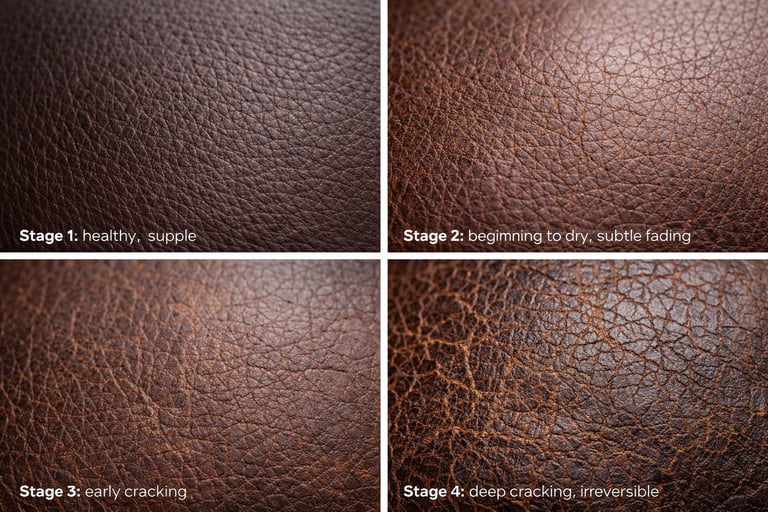
The Four Stages of Leather Damage
Understanding where your leather currently sits helps you know what's still fixable and what isn't.
Stage 1 — Healthy
The leather feels soft and slightly supple when you press it. The color is rich and consistent. There's a slight natural sheen but no stickiness. No visible lines or creasing beyond normal seat contours. If your leather is here, a simple monthly conditioning routine keeps it here indefinitely.
Stage 2 — Early Drying
The leather starts to feel slightly stiff, especially in the morning before the car warms up. The color looks marginally lighter or more faded than it did originally, particularly on surfaces that get direct sun. You might notice very fine surface lines starting to appear on high-contact areas like the driver's seat bolster. This stage is fully reversible with regular conditioning. A professional conditioning treatment can restore a lot of what's been lost.
Stage 3 — Active Cracking
Visible cracks have formed, usually on the seat bolsters, the top of the backrest, and along any areas that experience repeated bending. The leather feels noticeably stiff and may make a faint creaking sound when you sit down. The color has faded significantly in sun-exposed areas. At this stage, conditioning can stop further damage and improve appearance, but the existing cracks are permanent surface features. A professional leather repair treatment can minimize their appearance but not eliminate them.
Stage 4 — Structural Failure
The leather has cracked deeply, is peeling in places, and may have sections where the surface coating is separating from the hide beneath. No conditioning product fixes this. At this point, the conversation is about leather repair, reupholstery, or replacement seat covers. This is a $600 to $2,500 conversation, depending on the vehicle. We see this on cars as young as 5 years old in Florida, when the seats were never treated.
Florida's Specific Threats to Your Leather
UV Rays
Florida receives more sunshine than almost any other state (We are the Sunshine State after all). UV rays don't just fade leather's color — they break down the chemical structure of the surface coating and the hide itself, accelerating drying and making the leather brittle. A car parked outside in Tampa or Clearwater for a year absorbs more UV damage than a similar car in Chicago would in three years.
Interior Heat
On a 90°F Florida summer day, the interior of a parked car can reach 130°F to 160°F within 20 minutes. At those temperatures, the natural oils in leather evaporate rapidly! The leather expands under the heat and then contracts when the air conditioning kicks in. Repeated daily over months and years, this thermal cycling physically stresses the leather fibers and accelerates cracking along flex points.
Humidity
Here's the counterintuitive one: high humidity doesn't protect leather. Florida's humidity is the wrong kind of moisture. It encourages mold and mildew growth on leather surfaces and actually disrupts the leather's own moisture balance. Leather needs conditioned oils, not ambient water vapor. High-humidity environments can also cause leather dyes to transfer or bleed, and can make surfaces sticky over time if not properly maintained.
The Products You Actually Need
You do not need an elaborate product lineup. Three things cover everything:
A quality leather cleaner.
Not a multi-surface wipe, not a household cleaner, not dish soap. A pH-balanced cleaner formulated specifically for automotive leather. It removes body oils, dirt, and product buildup without stripping the leather's conditioning. There are tons of great options. Do some research and find the one you like the best.
A leather conditioner.
This is the non-negotiable. It replenishes the oils that heat and UV pull out and keeps leather flexible. Leather Honey, Lexol Conditioner, and 303 Leather Conditioner all perform well; however, do some research to find one that you like the best.
IMPORTANT
Avoid anything with petroleum distillates or silicone — they can temporarily make leather look good while actually drying it out faster over time.
A microfiber applicator pad or soft cloth.
Nothing special is needed here. A soft microfiber cloth or an applicator pad works fine. Never use abrasive cloths or paper towels on leather.
The Monthly Routine (60 seconds)
Once a month, do this:
Step 1. With a clean microfiber cloth, apply a small amount of leather cleaner to the seat surface and wipe it down gently. You're removing surface oils, sweat, and dust that have built up. Don't drench the leather — 1 or 2 sprays is enough. Then let it dry for a second.
Step 2. Apply a recommended amount of leather conditioner (Different for every brand) to your applicator pad. Work it into the leather in circular motions, covering the entire seat surface, including the sides and back of the backrest. The leather will absorb it relatively quickly if it's dry.
Step 3. Let it settle, then buff off any excess with a clean, dry microfiber cloth. The surface should feel slightly softer and look richer in color.
In Florida specifically, we recommend doing this at least every four weeks. The combination of heat, UV, and humidity means your leather loses its conditioning faster here than it would almost anywhere else.
How a Professional Detail Fits In
The monthly 60-second routine is maintenance. It's what you do between professional treatments to keep things stable.
Once or twice a year, depending on how much direct sun your car gets and how heavily the interior is used, a professional interior detail adds a layer of deep cleaning and conditioning that the DIY routine can't fully replicate. A professional will clean areas you won't think to clean, use commercial-grade conditioners applied with tools that work the product deeper into the hide, and address any early issues before they progress.
Think of it the way you think about brushing your teeth versus going to the dentist. The daily habit does the maintenance work. The professional visit catches what the daily habit misses.
The Bottom Line
Leather care in Florida is not complicated. It's just consistent. The cars we detail that have immaculate leather at 8, 10, and 12 years old are not special — they're just owned by people who conditioned their seats once a month and didn't let them bake in the Florida sun without protection.
The cars that need reupholstery at year 5 are almost always owned by people who didn't know this was something they needed to do. Nobody told them. The dealership didn't mention it. The car didn't come with instructions.
How We Help
If your leather is already past the point where the DIY routine isn't enough, or you just don't want to deal with it, that's exactly what Road Hog is here for. We come to you, we assess where your leather is, and we get it back to as close to new as possible.
(727) 263-1464
Tampa, Greater Carrol Wood, Westchase Lutz, Temple Terrace, Clearwater, Belleair, Dunedin, Largo, Oldsmar, Eastlake, Pinellas Park, Safety Harbor, St. Petersburg, Seminole