What Happens to Your Car Every 30, 60, and 90 Days Without a Detail
Most Floridians think their car's paint looks fine. They wash it occasionally, run it through a drive-through tunnel wash when it gets bad enough you can feel the dirt, and don't think much beyond that. The damage is happening anyway. It's just not visible...... yet!
Here's what's actually going on between details — broken down by timeline so you can see exactly what you're paying for (or paying to fix later).
This timeline assumes an unprotected or minimally protected vehicle parked outside daily in Florida conditions. Ceramic coatings and paint sealants slow the process significantly — but don't stop it without maintenance
Before We Get Started
The First 30 Days: The Silent Phase
This is where most people feel safe. The car looks clean. The interior smells fine. Nothing appears to be going wrong.
The damage happening in this phase is invisible to the naked eye — which is exactly what makes it dangerous.
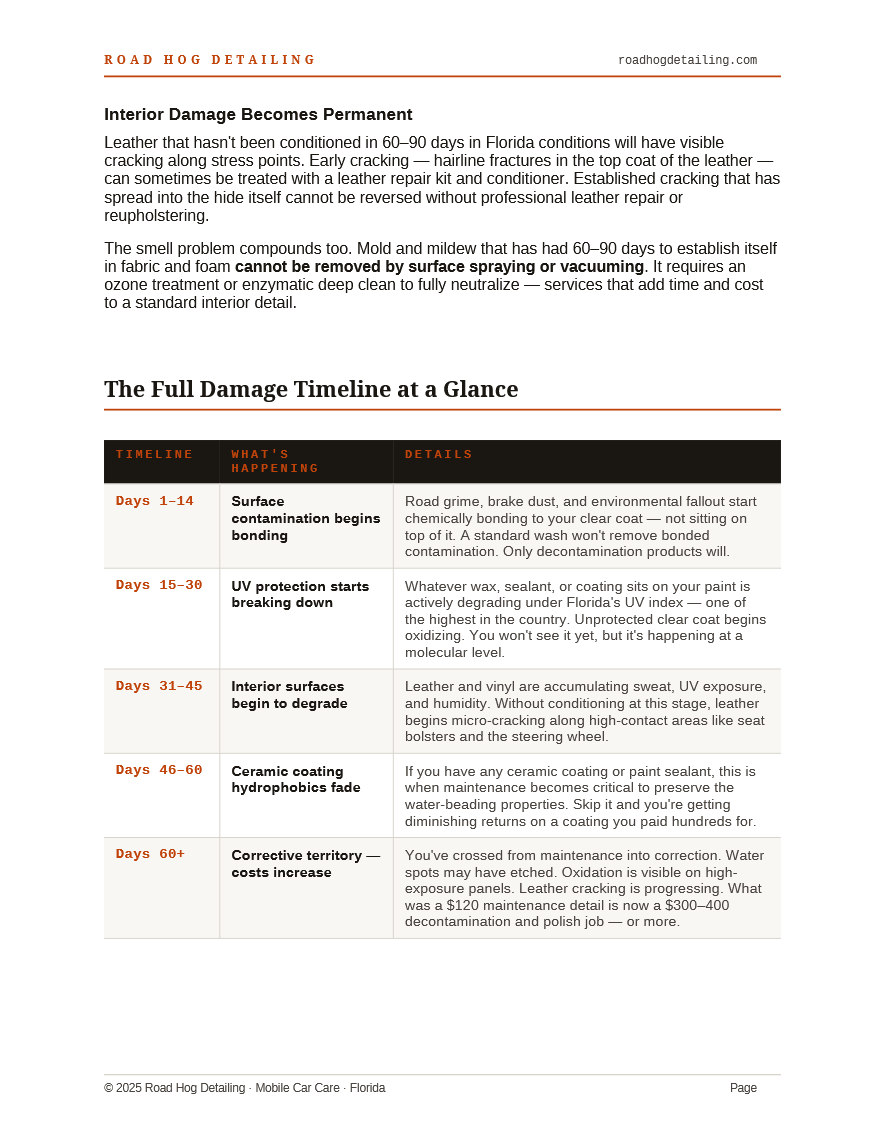
Days 1–14: Contamination Bonding
Every time you drive, your car is creating and piling up brake dust, industrial fallout, and road grime. These aren't just sitting on top of your car's paint waiting to be washed off. As soon as 24 hours, they begin chemically bonding to your clear coat.
A standard wash with soap and water removes loose dirt that is sitting on the surface. It does not remove bonded contamination. That requires a dedicated iron remover and clay bar treatment— the kind that's part of a proper detail can't be found at a drive at any drive thru wash.
The longer bonded contamination sits, the deeper it embeds, the more damage it does. Iron particles from brake dust can physically penetrate clear coat and cause rust blooms under the surface that are invisible until they erupt months later.
Days 15–30: UV Degradation Begins
Florida's UV index is among the highest in the United States (No surprise there). On a clear summer day, it regularly hits 10–11+ on the UV index scale — officially classified as "extreme." For context, UV levels above 6 are enough to cause skin damage within a few hours of exposure. Your car, sadly, doesn't have sunscreen.
Whatever protection layer sits between Florida's sun and your clear coat — wax, paint sealant, or ceramic coating — is being actively consumed. Wax begins breaking down in just the 1 week in Florida conditions. Sealants last longer but still degrade without maintenance. Even ceramic coatings lose hydrophobic performance over time.
During this phase, the degradation is under the surface. You'll start to notice it as a subtle loss of gloss and depth — your paint looks "flat" even after a wash. Most people chalk this up to the car just getting older. It's actually the protective layer failing.
Before We Get Started
Things like the old school wax in Florida conditions lasts 4–6 weeks, not the 6–8 months the label claims alot of the time. In Florida sun, plan for 6 weeks maximum before reapplication
Days 30–60: Visible Damage Starts
This is where the "it looked fine last month" phase ends. Damage that was happening invisibly now starts showing up where you can see it — if you know where to look.
The Interior Starts to Turn
It is so easy to neglect your car's interior, random trash, crumbs from the kids, etc. For example leather and vinyl are not self-maintaining. Without regular conditioning, leather loses the oils that keep it supple. You'll see the first signs of drying along the seat bolsters — the raised edges of seat cushions — and at stress points on the steering wheel!
In Florida's humidity, a different problem occurs: mold and mildew. Moisture trapped in seat fabric, floor mats, and the carpet padding beneath them starts creating conditions for microbial growth at around the 45-day mark for cars that aren't regularly ventilated and cleaned. Most Florida cars have some form of plant life growing in them with out you even knowing.
Water Spots and Etching
If your car is parked near a lawn or driveway that gets sprinkler coverage — which is most parking these days— hard water mineral deposits are etching your paint. Florida's water supply is notoriously hard. When sprinkler overspray lands on your hood and evaporates, it leaves mineral deposits behind.
In the first two weeks, these can often be removed with a water spot remover product. After 30–60 days of repeated exposure and baking in the Tampa bay sun, they etch into the clear coat . At that point, they can require polishing to remove — not a product, not a wash, not a wipe, actually paint correction.
The Ceramic Coating Maintenance Window
If you've invested in a ceramic coating — which we do recommend — the 6–8 week mark is when maintenance becomes critical. The coating's hydrophobic properties (the water-beading effect that makes coated cars so satisfying in the rain) degrade without upkeep. Constant neglect also leads to the coating failing years sooner then it would have, costing you hundreds.
Skipping maintenance doesn't void the coating, but it does mean you're getting diminishing returns on a service that often cost thousands of dollars. A simple maintenance detail refreshes the coating's performance for another 6–8 weeks.
Real Exsample
We detailed a 2021 white Tesla Model Y that we would see about twice a year. At the 60-day mark post-detail, the owner noticed the paint no longer beaded water. By month three, water spots from rain and the neighbors sprinklers had etched into to panels. The polish correction to fix those spots cost more than four regular maintenance details would have over the same period.
Days 60–90: Corrective Territory
This is the most expensive phase. Not because something catastrophic has happened, but because the accumulated neglect from the first 60 days has now compounded into damage that requires correction rather than maintenance.
Here's the practical difference: maintenance keeps your car in good condition. Correction restores it from a degraded state. Correction costs significantly more, takes longer, and in some cases — advanced oxidation, deep etching, cracked leather — cannot fully restore what was there before.
Paint Oxidation Becomes Visible
Clear coat oxidation starts as a subtle dullness. By the 60–90 day mark on an unprotected car in Florida, it starts showing as a white, chalky haze on high-exposure panels — the hood, roof, and trunk lid take the most sun.
Stage 1 oxidation (dull, slightly hazy) can be corrected with a single-stage polish.
Stage 2 (clearly chalky, rough to the touch) requires a two-step correction.
Stage 3 oxidation means the clear coat itself is failing and at that point you're looking at a respray, not a polish — a cost measured in thousands, not hundreds.
Most cars in Tampa bay reach Stage 1 oxidation within 2–3 years. Most of those owners think their car just looks "old." It's not age. It's a maintenance problem.
Interior Damage Becomes Permanent
For example leather that hasn't been conditioned in 60–90 days in Florida heat will have visible wear along stress points. Established cracking that has spread into the hide itself cannot be reversed without professional leather repair or reupholstering.
A smell problem compounds too. Mold and mildew that has had 60–90 days to establish itself in fabric and foam cannot be removed by surface spraying or vacuuming. It can lead to an ozone treatment or enzymatic deep clean to fully neutralize — services that add time and cost to a standard interior detail.
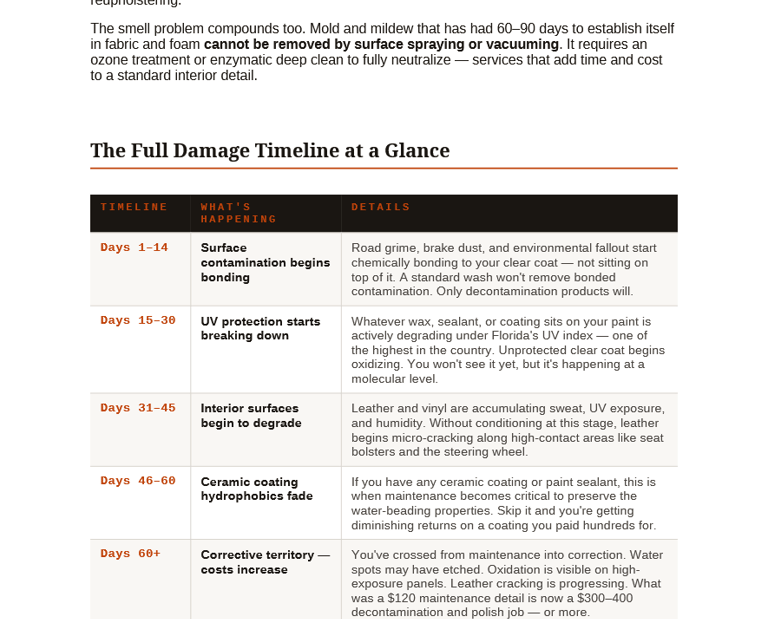
The Full Damage Timeline at a Glance
The Financial Case for Detailing More Often
We're going to be direct about the economics here, because it's the most convincing argument and the one most people never hear from a detailer.
Maintenance vs. Correction Costs
A standard maintenance detail — the kind that keeps a well-maintained car looking great — runs $120–180 for most vehicles at Road Hog. That covers a thorough exterior wash and decontamination, paint inspection, protection top-up, and a full interior clean and condition.
A corrective detail — the kind required when a car has been on a neglect schedule — starts at $280–320 and goes up significantly based on the extent of paint correction required, interior deep cleaning needed, and any specialty treatments (leather repair, ozone odor treatment, headlight restoration).
Four maintenance details at $150 each = $600 per year. One corrective detail every six months = $560–640+ per year — and your car is in a worse condition. The math doesn't favor less-frequent detailing.
Resale Value
Kelley Blue Book and independent dealer data consistently shows that paint condition is one of the top three factors in used car valuation, alongside mileage and accident history. A car with "good" versus "excellent" exterior condition represents a difference of $800–2,500 in most mid-range vehicle categories.
A regular detail schedule isn't a luxury. Over a five-year ownership period, it's typically the single highest-ROI maintenance investment you can make on your vehicle — higher than any modification, and compounding over time.
THE BOTTOM LINE
Detailing your car every 6–8 weeks in Florida costs less per year than corrective detailing twice a year — and it keeps your car in the condition that holds its value. The only argument against it is convenience, and that's exactly what a mobile detailer solves.
So How Often Should You Actually Detail in Florida?
The national advice of "twice a year" was written for a different climate. Here's our actual recommendation for Florida drivers:
Every 5–6 Weeks
If your car parks outside daily, you live within 10 miles of the coast, or you drive more than 1,200 miles per month. Salt air, high UV, and high mileage accumulate contamination and break down protection faster than any other combination of factors.
Every 6–8 Weeks
The standard recommendation for most Florida drivers. Enough to stay ahead of contamination bonding, UV degradation, and interior wear before any of them cross into the corrective category.
Every 8–10 Weeks
If your car has a ceramic coating and you're doing the 15-minute monthly maintenance routine between visits (see our maintenance guide), you can stretch to this interval without falling behind. The coating buys you time — but doesn't eliminate the need for professional maintenance.
Not sure where your car falls? We'll tell you honestly when we see it. We never recommend services a car doesn't need, and we'll always give you our honest assessment of what interval makes sense for your specific vehicle, parking situation, and how you use the car.
(727) 263-1464
Tampa, Greater Carrol Wood, Westchase Lutz, Temple Terrace, Clearwater, Belleair, Dunedin, Largo, Oldsmar, Eastlake, Pinellas Park, Safety Harbor, St. Petersburg, Seminole